Heavy menstrual bleeding is a common problem faced by women of different age groups. While medicines can help in many cases, some women continue to experience excessive or prolonged bleeding despite treatment. In such situations, doctors often recommend hysteroscopy to identify the exact cause and, when possible, treat it at the same time.
Hysteroscopy has become one of the most effective and minimally invasive tools for evaluating heavy menstrual bleeding, especially when scans do not provide clear answers.
This article explains what hysteroscopy is, when it is recommended for heavy periods, how it helps, and what women should expect from the procedure.
What Is Heavy Menstrual Bleeding?
Heavy menstrual bleeding, medically called menorrhagia, refers to periods that are excessive in amount or duration.
A woman may have heavy menstrual bleeding if:
- Periods last longer than 7 days
- Pads or tampons need to be changed every 1–2 hours
- Large blood clots are passed
- Bleeding affects daily activities
- Symptoms of anemia such as fatigue or dizziness occur
Heavy menstrual bleeding is not a disease but a symptom of an underlying uterine or hormonal condition.
What Is Hysteroscopy?
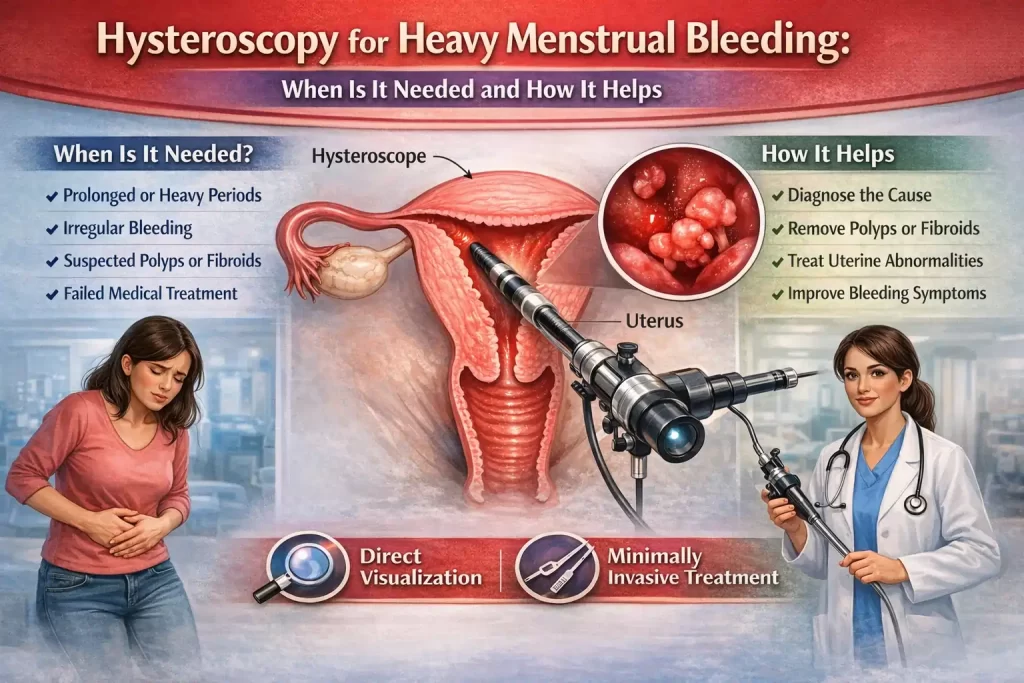
Hysteroscopy is a minimally invasive gynaecological procedure that allows the doctor to look directly inside the uterus using a thin, lighted instrument called a hysteroscope.
The hysteroscope is gently passed through the vagina and cervix into the uterus, providing a clear and magnified view of the uterine cavity on a screen. This direct visualization makes hysteroscopy far more accurate than scans alone.
Why Is Hysteroscopy Recommended for Heavy Menstrual Bleeding?
Hysteroscopy is recommended when heavy menstrual bleeding:
- Does not respond to medications
- Has no clear cause on ultrasound
- Is recurrent or worsening
- Occurs after the age of 40
- Is associated with irregular or intermenstrual bleeding
It helps doctors identify structural causes of heavy bleeding that may otherwise be missed.
Conditions Detected by Hysteroscopy in Heavy Periods
Hysteroscopy is particularly useful in diagnosing:
Endometrial Polyps
Small growths arising from the uterine lining that can cause heavy or irregular bleeding.
Submucosal Fibroids
Fibroids located inside the uterine cavity that interfere with normal uterine contraction and cause excessive bleeding.
Endometrial Hyperplasia
Abnormal thickening of the uterine lining due to hormonal imbalance.
Uterine Septum or Abnormalities
Structural abnormalities that may contribute to abnormal bleeding.
Retained Tissue or Adhesions
Seen after miscarriage or previous uterine procedures.
Diagnostic vs Operative Hysteroscopy
Diagnostic Hysteroscopy
Performed to inspect the uterine cavity and identify the cause of heavy bleeding. It is usually a short procedure and may not require anesthesia.
Operative Hysteroscopy
If a problem is identified, treatment such as removal of polyps, fibroids, or abnormal tissue can be done during the same procedure using specialised instruments.
This ability to diagnose and treat in one sitting is a major advantage of hysteroscopy.
How Hysteroscopy Helps Treat Heavy Menstrual Bleeding
Hysteroscopy directly targets the cause of bleeding rather than just controlling symptoms.
It helps by:
- Removing polyps or fibroids causing bleeding
- Treating abnormal uterine lining
- Reducing the need for major surgery
- Improving menstrual flow and quality of life
Many women experience significant improvement in bleeding after hysteroscopic treatment.
Is Hysteroscopy Painful?
Most women experience minimal discomfort during hysteroscopy. Diagnostic hysteroscopy often causes mild cramping similar to period pain.
Operative hysteroscopy may involve temporary discomfort after the procedure, which is usually well controlled with simple pain medication.
The majority of patients can go home the same day.
Recovery After Hysteroscopy for Heavy Bleeding
Recovery is generally quick.
Most women:
- Resume normal activities within 24–48 hours
- Experience mild cramping or spotting for a few days
- Are advised to avoid intercourse and tampon use for a short period
Heavy bleeding, severe pain, fever, or foul-smelling discharge should be reported immediately.
Advantages of Hysteroscopy for Heavy Menstrual Bleeding
Hysteroscopy offers several benefits:
- Accurate diagnosis through direct visualization
- Minimally invasive with no cuts or stitches
- Short recovery time
- Reduced hospital stay
- Lower risk compared to major surgery
It often helps avoid unnecessary hysterectomy in many women.
Are There Any Risks?
Hysteroscopy is considered safe when performed by an experienced gynaecologist. Rare risks include infection, bleeding, or uterine perforation.
The overall complication rate is low, especially in diagnostic procedures.
When Is Hysteroscopy Not Enough?
Hysteroscopy may not be sufficient when:
- Bleeding is caused by large fibroids outside the uterine cavity
- Adenomyosis is present
- Hormonal imbalance is the primary cause
In such cases, additional medical or surgical treatment may be required.
Who Should Consider Hysteroscopy for Heavy Periods?
Hysteroscopy is especially useful for:
- Women over 40 with heavy periods
- Women with recurrent heavy bleeding
- Women not responding to medication
- Women with suspected polyps or fibroids
- Women with abnormal ultrasound findings
When Should You See a Doctor?
You should consult a gynaecologist if:
- Heavy bleeding persists for multiple cycles
- Periods interfere with daily life
- Anemia symptoms develop
- Bleeding occurs between periods or after menopause
Early evaluation can prevent complications and major surgery.
Final Thoughts
Hysteroscopy is a safe, effective, and minimally invasive procedure that plays a key role in diagnosing and treating heavy menstrual bleeding. By directly identifying the cause inside the uterus, it allows targeted treatment and often avoids unnecessary major surgery.
For women struggling with persistent heavy periods, hysteroscopy offers clarity, relief, and faster recovery when performed at the right time.
If you are experiencing heavy menstrual bleeding that does not improve with medication, consult a gynaecologist to determine whether hysteroscopy is the right option for you
Frequently Asked Questions (FAQs)
What is hysteroscopy for heavy menstrual bleeding?
Hysteroscopy is a minimally invasive procedure that allows doctors to examine the inside of the uterus to identify and treat causes of heavy menstrual bleeding such as polyps, fibroids, or abnormal uterine lining.
When is hysteroscopy recommended for heavy periods?
Hysteroscopy is recommended when heavy menstrual bleeding does not improve with medications, ultrasound findings are unclear, bleeding is recurrent, or bleeding occurs after the age of 40.
Can hysteroscopy treat heavy menstrual bleeding?
Yes. If the cause of heavy bleeding is due to uterine polyps, small fibroids, or abnormal endometrial tissue, hysteroscopy can both diagnose and treat the condition in the same procedure.
Is hysteroscopy painful?
Most women experience mild discomfort or cramping similar to menstrual pain. Diagnostic hysteroscopy is often painless, while operative hysteroscopy may cause temporary discomfort after the procedure.
How long does hysteroscopy take?
Diagnostic hysteroscopy usually takes 10–15 minutes. Operative hysteroscopy may take longer depending on the treatment required.
Is anesthesia required for hysteroscopy?
Anesthesia may not be required for diagnostic hysteroscopy. Operative hysteroscopy may be performed under local, spinal, or short general anesthesia depending on the procedure.
How long is recovery after hysteroscopy?
Most women can return to normal activities within 24–48 hours. Mild spotting or cramping may occur for a few days.
Are there risks associated with hysteroscopy?
Hysteroscopy is generally safe. Rare risks include infection, bleeding, or uterine perforation, especially in operative procedures.
Can hysteroscopy prevent the need for hysterectomy?
Yes. By accurately diagnosing and treating the cause of heavy bleeding, hysteroscopy can help many women avoid major surgery like hysterectomy.
Is hysteroscopy suitable for women over 40 with heavy periods?
Yes. Hysteroscopy is especially useful in women over 40 to rule out endometrial abnormalities and manage heavy bleeding effectively.
Can heavy bleeding return after hysteroscopy?
Recurrence depends on the underlying cause. While many women experience significant improvement, regular follow-up may be required in some cases.
When should I consult a doctor after hysteroscopy?
You should contact your doctor if you experience severe pain, heavy bleeding, fever, or foul-smelling discharge after the procedure.
